Boston marathon bombing continues the violence since 9-11

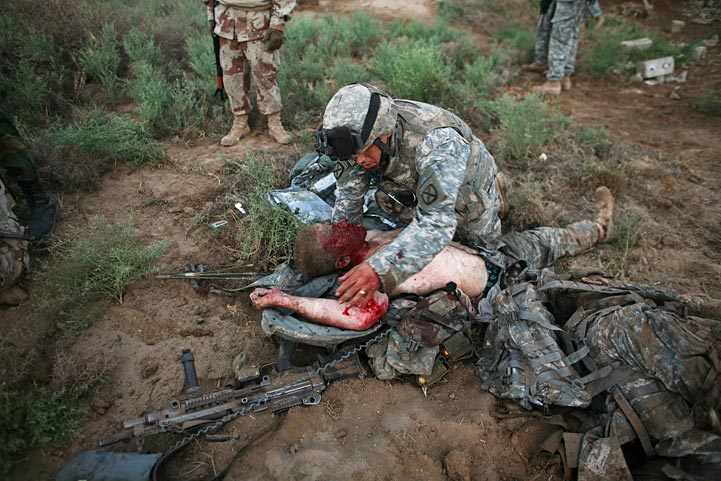
Iraq soldier hurt

Yesterday I had one of the best runs in my life. I fell into a good pace and finished strong, while in Boston, some of the runners finished in a smokey nightmare. As I listened to the reports of the bomb blasts, my imagination began to fill in the picture, perhaps making it worse than seeing the effects themselves. I gave a sad shiver and thought “Why did someone do this? Why, why, why?”

Since 9-11, violence has been in the news. We’ve gotten regular doses of it, but most of us only through pictures and video and second-hand accounts. We’ve seen violence without experiencing it. A virtual experience that affects us at some superficial level. Invading Afghanistan, bombings in Europe, invasion of Iraq, mass shootings. I’ve gotten used to it, although I’ve not forgotten.

Is the media still showing pictures of our over 50,000 wounded soldiers? The over 1500 soldiers being carried into vehicles having their limbs blown off or hanging on until they are amputated? Did they ever?

I don’t know.

I stopped my daily following of the news a while ago. Maybe that’s why when I hear about violence, I don’t focus on the event, but I see it as a continuation of the violence of 9-11. Part of a War on Terror, where terror has become not so terrible, because time heals all wounds and distance makes it surreal. So we’ve settled into a comfortable place, where we can nod our heads and allow our soldiers and administrators to set camp in other countries, plant an airbase, send our drones to fly into neighborhoods and fire off rounds. The War that allows us to ignore the over 100,000 Iraqi civilians who were killed and continue to be killed. Civilians who ran out into a smokey streets, maybe like the runners and onlookers in Boston did, confused, scared, punctured with glass, or choking, or maybe lying on the ground, not feeling one of their legs. The War on Terror has became a theme that has too easily turned into a way of life allowing us to accept the news about men, women, and children who were accidentally caught in the crossfire, and forget about the soldiers with the tough task to protect them as they fight.

This acclimation devalues their plight and their sacrifice.

We are certainly good-intentioned, and probably empathetic to you about that father of your’s that we accidentally killed. But we had no choice, you see? We’re so scared that we need to keep fighting this War on Terror, or maybe we’re so accepting that we don’t really care. It’s nothing personal, son.

But that son is going to take it personally.

Violence creates more violence.

Boston should help us see that this violence is strong and meaningful and damaging, wherever it is happening, whoever is doing it. All violence comes at a cost. And in this environment of violence, call it the War, call it whatever, there is no enemy that is going to come forward and surrender. There is no winner until one side completely crushes the spirit of the other…until one side approaches such a reputation for committing violence that no one wants to even try to face them.

She told me, “Love is a feeling. It’s not about anything else.”

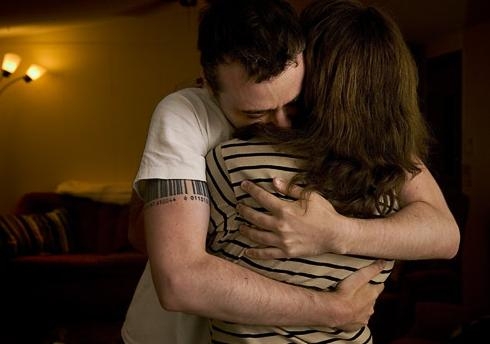
co-dependent hug

Our relationship had been broken almost from the start. A tentative dance between two people with two left feet. The final break was years later, and it was the first time after a break-up that I didn’t rush to fill that void that was left. I felt neither happy or sad. I felt..nothing. Maybe that was what was meant by “being at peace.”

Anyway, her and I. We still talked.

So I sat and listened when she said, “Love is a feeling. It’s not about anything else.”

I shook my head. “Love needs an object. You love something or someone because of some value you get from it or him or her. You need to define love in that context.”

I thought about that some more, and realized that there was something significant in what she said. Love is a feeling. And feelings originate within you. They are created by you. And the saying how you can’t control love has a little truth in it, too. Love is when you value someone more than yourself, which is an irrational state. It’s totally emotional, illogical. But when that love ceases to come from you, and your control over love is given over to the object or person, this is where it can slide into a coup, where you become helpless to the situation or the other person.

There is a fine line between seeking love from another, and finding someone to give your love to.

Relationships can be two people who are seeking validation and value from each other and their trade results in a balanced relationship. However, I don’t know if they love each other..maybe they like the attention the other is giving to them. The latter is not love.

So she was right. Love starts with you. Who you choose and the time and effort you’re willing to spend on them. You control that decision. No one else.

How love turns to dependence

book

I’ve been reading the non-fictional works of Steven Pressfield. He writes about Resistance (no typo there. He takes Resistance seriously) preventing you from pulling the trigger on creative endeavors, be it writing, starting a business, or implementing a major self-improvement in your life. In one part, he writes about how we may rely on icons to help us instead of helping ourselves. That’s when I realized something embarrassing:

I’d turned him into the icon that he warned about.

As my thoughts frequently turned to the resistance he’d written about and overcome, I realized I was avoiding the resistance I needed to face myself. I wanted to revisit his encouragement, instead of doing the work. The most ironic thing is, he’s the best guide of all, because he has no system of rules, just one simple direction: Stop distracting yourself and do the work.

If your guide starts presenting rules, he ceases to become your guide. Rules are for those who can’t control themselves, or their power, and they encourage that mentality. A guide who gives rules starts becoming less of a guide, and more of a dictator. I found myself picking up Pressfield’s book like a religious doctrine. I felt good after reading it, sure, but then I realized that his writings had become a crutch. And it became addictive, and restrictive.

The same applies to your friends or partners if they want you to be a certain way and follow some definition of what they want. And the same applies to our political leaders who want to help us, but sometimes pass some laws that restrict us.

These groups should empower us, not take power from us. And it’s easy for us to give our accountability away. To a friend, lover, priest, guru, or lawmaker.

Pressfield’s works are empowering, but I made them my source of power instead of claiming the power he was showing was already in me.

The good feelings I would get when picking up his book and reading a bit, became just that. Good feelings and little else. It’s nice to feel good. But if you want to produce something, feelings don’t do much. Producing something… something good, and beautiful and from you… that requires practice. Showing up everyday and doing the work.

And far from being a selfish act, this internal source of power is more selfless, because it doesn’t require you to take power from others. It gives you the capacity to generate this power at will. When you can do that, you can share it without fear, because you will have it always. And then the world stops becoming a series of partners or jobs or cars or clothes to give you validation. You stop collecting stuff in a world of scarcity where you need to guard those partners or worry about that job. Instead, the world becomes abundant, and at that moment, you not only make yourself happy, but you will unconsciously spread that happiness to everyone you meet.

As much as it hurts, you’ve gotta fall to get higher

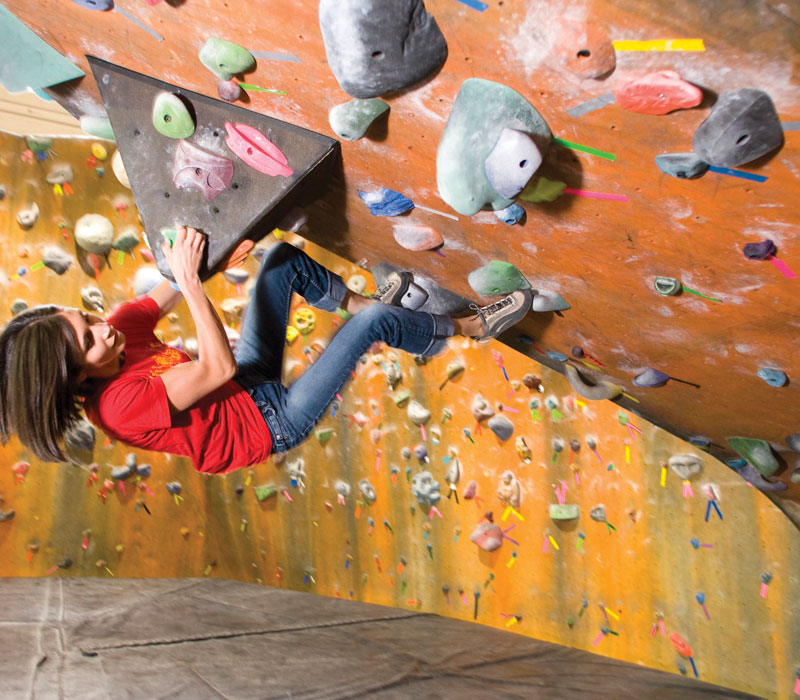
indoor_bouldering_utah

I was climbing yesterday. I sat at the wall and watched with envy as a guy calmly twisted his way up one of the most difficult routes. His body was almost parallel with the ground at times! It was beautiful. And I was jealous. Afterwards, I started talking to him and learned a lot, not from what he told me, but from what he did afterwards. I learned that my envy was misdirected towards what he did, and should’ve been towards what he didn’t do.

“Did you just do that black and purple route?” I asked.

“Yea,” he nodded. He had tight curly hair that covered his head and came down to form a neat beard around his face.

“I don’t think I’ve ever seen someone complete that,” I said. “I don’t even think I’ve seen someone try it, but it’s hard to tell.”

He smiled. “It’s tough. I worked at it though. I did it so many times that now I know exactly how to do it.”

I was jealous. I was inspired, too. But I thought more about how he did it, and how I couldn’t. I didn’t think about how it was good that someone from the crew here at the wall had practiced and mastered that route. My insecurity hummed loudly in the back of my head so I didn’t really listen to what he said.

I tried another route, one that I’d been trying to get. Failure. I reached for that hold, the problem one. Slip. A short fall to the padded ground.

I sat down and let my throbbing shoulders and forearms recuperate. The guy I had been talking to was now going up another difficult route. I watched expectantly, as he reached carefully and methodically, pulling himself up. A small hold that required significant grip strength was the next one, and he reached for it. And missed. He rolled into his fall, and got back up. He said nothing and sat down. He tried again. I knew he would make it this time. But he failed. But he tried again. And failed again. And then again. Fail. And then again. Fail.

I often hear that failure makes you stronger. I hear it, but like many things people tell you that are good and right and you should do, I nod and don’t act on it. Maybe because of ego, maybe laziness. Then I have the opportunity to see someone who is skilled and how he failed. Again and again and again. And I’m reminded of how failure works:

Failure sucks. You fall. And it hurts.

And it doesn’t matter what you’ve accomplished before, because at present, you’re failing. But that’s the point. If you’re not failing, you’re sitting, watching the wall, or going over and over the same places you’ve gone before, and you’re not getting better. And you know it. But at least you’re not getting hurt. At least you’re not losing face, right?

We focus on the success. I looked at what the guy did, but what made me appreciate what he did was what he didn’t do afterwards. On the second route, he didn’t make it up to the top. He repeatedly didn’t make it. And I didn’t see him make it that day. But he kept trying.

I tried my route several more times yesterday. I never reached the top. But I will. Because if you’re paying attention, failure teaches you, and then you make it. It teaches you to put in the time. Consistently. Over and over and over. And maybe that time gets you to the top of a climbing route. Or graduating from school. Maybe it’s finishing writing a book. Maybe it’s doing a lifting regime to strengthen your body, or a meditation practice to settle your mind.

Maybe most importantly, failure teaches you that things aren’t alright, and they never will be.

There’s always going to be that new route that you’re not going to be able to do. And you learn to accept that. Or maybe you learn to accept your father’s judgments, because sometimes, people don’t change. Or maybe it’s facing up to your own faults, accepting yourself so that life stops being a competition to win, and instead it’s an opportunity to learn. To help others. To spread the love, instead of hoarding it all for yourself because you just can’t afford to let any out.

And even if you don’t make it, you know something now. You’re no longer a spectator. Because you’ve put in real, intelligent effort, and you have skills that the consumers and the critics who are only watching may have some idea about, but they don’t really know like you do. Because you decided to wade into the mess.

Congratulations. You’re no longer afraid to get dirty, afraid to fail, or too lazy to try.

You are in it now.

And this is where life gets good.
A Valentine’s Life

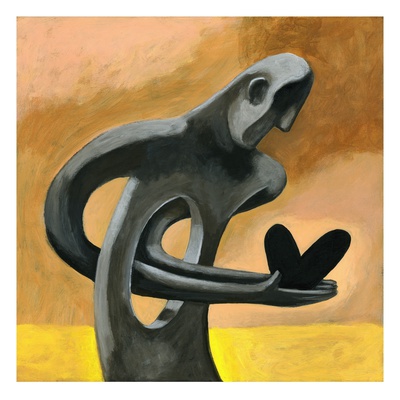
Love your self

The search for love is universal. Some search knowingly, others unconsciously, but we all seek it. Biologically driven, sometimes mindful, other times careless, the search usually manifests outside of us. But true love is created internally. Even when we are in a couple, we are single, because the love we search for is built upon the love we must find in ourselves, for ourselves.

Love comes from a place of strength

We cannot use another’s love in place of our own. Love is needing someone, but still valuing his happiness over your own. Without that value, your feeling becomes just another want. Like wanting a box of chocolates or flowers. And that want comes from a place of selfishness, not self-esteem.

Learn to love yourself, then spread the love. Today, and every day.

We all need it.

And the topless writing begins…now.

back

I sit here, typing in front of my computer, sans shirt. Bare, beautiful, and cold. The Midwest has been downright unhealthy chilly the past few weeks. So why am I topless? I thought it was time to get some writing done. I thought it was time to be more productive.

Oftentimes my problem is finding focus, so I thought that it was time for some external motivators. No, not the carrot. But the stick. Sometimes we need it. I know that the best motivation comes from within, but sometimes we need some unpleasant consequences from our environment to help us along. Negative stimuli. And what’s a more natural negative motivator to prevent distraction than the cold? So…

No clothes until I’m done.

Sometimes we get ahead of ourselves. That long journey to that high peak where our goal sits is daunting when we think about it. As the saying goes, the journey of a thousand miles begins with one step. I was staring at the blank, white page. Unable to take that first step. Nothing. I was obsessed with the peak, imagining the finished product. And I distracted myself. Would it be good? Would it be good enough? I wanted it to be perfect, but there was nothing there yet to perfect!

In the creative arts, we need to let the expression flow, and thinking is counterproductive to opening up our imagination.

I’m cold right now. But I am writing fast. The distraction was part of my problem. The other is my inability to produce things quickly. And in this day and age, well, in any day, efficiency makes you a pro. But especially today, in the midst of a thousand, a million, a billion voices clamoring around you, it’s pretty damn important.

The alternative to efficiency gets you a hobby. And that can be good. But making good art takes time and practice and not only getting people interested, but keeping them interested. And interest in today’s onslaught of data and media is a fleeting commodity. I want to sharpen that saw of skill before I’m too old to enjoy its fruits.

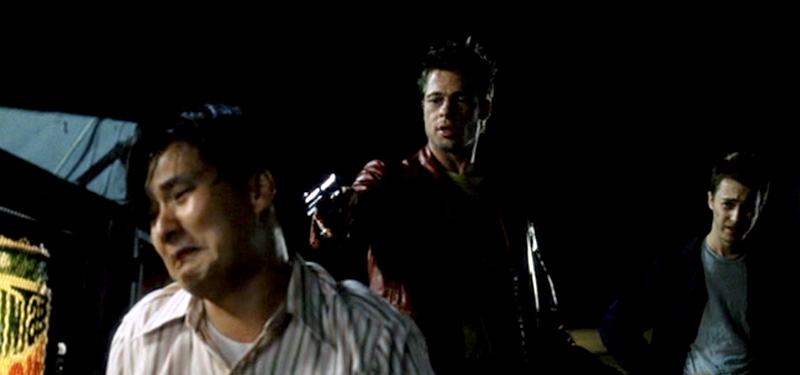
The same distraction from becoming a pro can be at play with an intellectual pursuit. Going to school to get that degree is going to take two, four, maybe six years. Too long a time. I’m too busy. I’m too old. These are distractions. When Raymond told the gun-toting Tyler he didn’t become a veterinarian because it was “Too much school” Tyler’s response was…

raymond

“Would you rather be dead?”

I’d rather just not be cold. So, here I sit, cold, banging out these sentences the fasted I’ve ever typed. And it’s working. Because I’m not distracted by my cat. I’m not falling for that hunger pang and running to the kitchen for “just a quick snack.” I’m not thinking, “Maybe my bathtub needs cleaned?” (I’m sure it does). I’m not worried about whether this will be good. About whether you will like it. I’m only producing.

And when you’re producing, you don’t think about what others want. And you don’t think about yourself. You are in the moment.

When we’re in the moment, we are genuine. We produce the best stuff. The truest stuff. The stuff people will love. Maybe not everyone. Probably not, actually. But who wants to produce the stuff that’s already been done? We’re here to capture people’s interest. And ultimately, we’re here to get some love. And part of being loved is making something other people value.

I hope that some day my writing will be valued by enough people that it makes the world a better place.

A warmer place.
Man, it’s cold.
But I think I’m done. And in record time.
Now, where did I throw my sweatshirt?

Why avoiding heaven should be at the top of your 2013 to-do list

Choices

Heaven is perfect. Everything to be understood is already understood. Any choices we make don’t change our happiness. We’re perfect. We have nothing to strive for. There is nothing more to know. A constant state stretching into infinity.

Heaven, perhaps not coincidentally, sounds like death.

Your actions are insignificant since everything will turn out as it should. During death, you become disordered into the system. But in heaven, everything is ordered. And since there is no disorder to shy from, the order is meaningless. And if there are any changes in heaven, they become meaningless, too.

This is why we must make choices with positive or negative consequences.

To have significance, our existence must include taking risks. There must be a negative outcome to suffer, so that there is a positive state for us to value. We must have a little suffering, a little wanting, a little desire, to make life worth living, actions worth taking, love worth making, and friendships worth building, because…

No desire means no love

The argument for a heavenly state is that we need to be content…we need to have gratitude with what IS before looking to what more can be. Desire leads only to more desire, unless checked by gratitude. Gratitude gives us peace. It keeps us grounded. It allows acceptance of what is, so our identity does not become wrapped up in what we do. Our selves always come before our job, or home, or looks, or our friends. If those things are stripped away, our gratitude for our humanity, for just having the dumb luck to be born, to exist, this profound truth will sustain us.

Gratitude allows us to value life. And valuing life itself gives us the reasoning for how we will use this life. Why we do something is as important as what we do.

But a heavenly gratitude without the passion to act is a divine lobotomy, stretching timelessly into oblivion

Human nature ties us all together. After we recognize that we all grow angry, fearful, happy, anxious, peaceful, lustful, needy… then we…then we can decide how to act. Will I be driven by my insecurity? Or by purpose and confidence and love?

As much as our natures are alike, our behavior differentiates us. Yes, we are all special, but only because of our behavior.

Our behavior makes us who we are

Our behaviors are based on our decisions, and we decide based on costs. Costs of how much we want to suffer, how much we want to risk losing something for what we love…Do we shoot for the love…or not?

Heaven is perfect. But that just isn’t good enough

So, don’t lose that desire. Carry heaven in your mind, but realize there’s more to you than the passive contentment behind those pearly gates.

To a new year of risk. To days that end with a resounding “hell yes!” or with a little fear because you don’t know what’s going to happen. And ultimately…doing what you love.

Cheers to 2013, friends.

The most effective way for you to stay safe from terrorism

stop terror, turn off tv

After the shooting at the Connecticut elementary school, I’ve been thinking of security. HL Menken said, “Most people want security, not liberty.” I contend that you cannot have security without liberty. Security is a feeling of empowerment that grows from liberty. Security is the confidence that whatever happens, you’ve got it handled. How can you be empowered if you’ve given up your security to others? Our government provides us some security, but it includes them taking our right to trial and ignoring any right to privacy by collecting our personal data.

The media, the so-called experts, or the government can tell us what threatens us, but we’re the ones who decide what is actually threatening and whether we will give up some of our freedom to protect ourselves.

Remember, the more power we relinquish to the institution for our security and peace of mind, the less of our mind we will use, and the less secure we truly are.

What kind of security do you want?