Recess like a child

recess revolution 3

I started my run, and it was like any other day. But when I made my way around the school parking lot this time, I heard screams. I continued jogging down the driveway, the screams mixed with a screeching sound. I kept going, and as I rounded the corner of the building, I finally caught sight of a playground full of children. The swing sets were swinging. Kids were scattered in small groups, playing made up games, while others clambered over jungle gyms. They looked like they were having fun. More fun than me. Then I thought, what happened to my recess?

I want recess back

Who took our recess anyway? Was it the high school administrators who just don’t have enough hours in the day to spare us? Or was it the colleges who don’t need you to have recess? No, it was me. High school offers arts and music. College offers the opportunity to make your own schedule and club network. But, intent on being productive, after high school and college, I forgot that the movement and unstructured socializing of recess is what keeps a person loose.

I made my way around the playground and noticed 4 or 5 kids lining up at the top of a small hill. There was some direction from the more authoritative members of the group, and then they all dropped to their knees and then their sides and rolled giggling down the hill. They were creating their own fun, maybe tired of the jungle gym and swing sets.

Recess keeps us thinking creatively. During my work day, even if I just take a walk to the coffee station and have a short conversation, I come back to my desk with more energy. More focused. Rested, and in fact more productive. Studies have shown this. The breaks during intense periods of study and work are important in resting the brain. It’s almost like the recuperation of muscle after you’re broken it down after exercise. And productivity decreases if we don’t take a recess.

The judge bangs down his gavel, “We will recess.”

We need a judge in our head, observing our actions. He is silent, patient, resolute. So when we lose our focus, when we blink our eyes and stare away from the screen to refocus them. When we raise our head and realize we’ve been in the same position for an hour. That’s when the gavel comes down.

BANG

“Time for a short recess.”
“But I just need to finish this part up, it’ll just take.-“
“I said, Recess.”
“Look, if I just bust through this, I will-“
“You will finish it, yes, but will it be right? Will you do it the same way, instead of thinking of a better way to do it?”
“I guess not.”
He points sternly out the window, “Now go play. It looks like your friends need a fourth for four square.”

Your strength is needed. Now…more than ever.

Some people think they know better than others. You know the type. They give advice on everything. They believe they have the system of do’s and don’ts that will work. They want what is best for you. And they believe they know what the best thing for you to do is. In fact, they think they know what is best for everyone.

Others believe it’s better for people to make their own choice. They believe people will strive, work, share, and care for others. Not because we’re forced to, but because in a stable system of laws, that is what we will do. They believe people should have the freedom to live how they want, but without hurting others. To choose what passion to follow, where to work, how much to pay, how much to get paid, what to buy, how to explore their own consciousness, and who to congregate with.

There are those who want a system of control because they want to protect people, not just from others, but protect them from making the wrong choices. They want to protect us from ourselves. They are cautious of people. Do they even trust people?

They like giving guidelines, and providing a program. They believe in a high standard of living, and they want everyone to have that standard, not just the opportunity for that standard, because they think everyone deserves it. And they will engineer a system using their formula of mandates that will get you this, regardless of how this effects the financial condition of the country. They will make it too affordable to pass up or they will cook it into the system so you have no choice.

These people truly want to help others.

And they believe they are the expert authority on that. And they believe in a central authority. Like a central bank that controls money, or a central insurance company that controls health care, or a central department of energy and agriculture to provide corporate welfare. Or a police authority that has taken our right to trial, so we can be arrested without charge.

Those who believe in people are different. They are courageous, because living an empowered life is damn scary. But that is why we are here. Not to make a perfect world, but to accept that life is not going to be perfect, and anything that is worth doing in life is risky. And caring about someone else is not about giving them something. It’s about being their friend and helping them face to face, not through a check delivered by a service taken from our paycheck.

We’re here to make choices, not have someone else make them for us.

We’re here to get hurt, mend, learn, and grow. And when we see someone else hurting, we’re here to extend our own hand and help them up. Not pay others to help them for us. Because people need to intimately know they are valued before they can do something of value. And because you cannot make someone care about you by forcing them to share with you.

We’re here to explore our passions and our own consciousness without being restricted on what we can do, unless it hurts another person.

We know that we cannot get as far alone as we can by joining others, but not in faceless networks. We’re here to share life in a community, because we must have the opportunity to learn that without guidelines or incentives, a rich life is one of honest collaboration with others.

We know that if we give leaders the authority to do things on behalf of us, we must remain aware of how they are using this power. And that we must stop them when we feel they are doing a disservice to us.

We know that we should treat everyone else how we would want to be treated. And so we act accordingly.

These people trust humanity to do the right thing.

Some might call these libertarian values.

But they are not.

They are called human values.

And I believe it is how we should live.

The secret to truly changing yourself

When I was in middle school, I noticed that I was smaller than most of the other kids. And I hated that. I hated my skinny arms and legs. So I started lifting weights. And eating… and taking supplements. I got bigger, but I always found fault. Even throughout college, I compared myself to other guys.

For years, I forced myself into this lifestyle until it became a habit… until one year. I stopped working out. I had met someone, the first person who showed care for me. We moved in together. I soon realized that I had never been training for me. Now, years later, I exercise for myself, for the good feelings I get. And I focus on getting fit, not big.

Changing something in your life means taking control. And where does that control come from? Your personality, values…your attitude, right?

So the first step in changing our actions is finding out what values are driving them. Is it because we’re unhappy with ourselves? Because no matter how much you “improve”, you will never become happy with yourself if you’re not already content with life.

Once you gain this self-awareness, then whatever changes you want to make aren’t hard, because…well…because you want them. When my goal changed from getting validation to being fit, it was almost unconscious. I didn’t obsess over becoming healthy. I didn’t hold myself to a strict program. I didn’t read books about why it was better to be more fit. I didn’t do those things because I didn’t need to do those things.

A measure of the value of a goal is how much you want to do the grunt work. But if the drive to change comes from inside you, you will embrace the grind and it will cease to be one. Facing the challenge of something new will become exciting, not paralyzing. The sacrifice won’t feel like a sacrifice.

But it won’t really work if you’re doing it because you think you must or you have no choice. You can’t do it if fear is driving you, or if you’re forced to.

People do change. We evolve. Just don’t force it. Evolution is natural. Other people and your environment can supplement a change in your values, but the truest values, the ones that drive us to do the right thing, always come from the inside.

So what’s the secret to really changing yourself?

Let go of what you think you need.

Free yourself. Because no one else will.

We were meant to evolve. And we have the self-awareness and freewill to do exactly that.

Taking off the blinders requires learning how to ignore

I have trouble sitting down to work sometimes. My focus is on many things, and so it is on nothing. Then I realized how to let go. And it was more than simplifying and prioritizing. It was the realization that I needed to acknowledge and then ignore many things. In order to get stuff done, I needed to ask myself throughout the day, day after day, week after week: “What do you want? What are you doing?”

The other day, I was returning from the bathroom to continue my writing and saw the new handheld vacuum I had purchased recently. I like tools, and this was a bright, shiny new one. Soon, I was unplugging it, having just swept the kitchen. I stopped suddenly and thought, “What am I doing? Why am I not writing?”

Vigilance is key

Neil Gaiman has a great analogy for making tough decisions in life. If your goal is a mountain, make sure your decisions are taking you towards that mountain, not away. The mountaintop is far so it’s ok if it takes you a long time to get there, as long you’re making your way to it.

My experience would make me add this to his analogy, “Make sure you’re not circling that mountain, neither going towards it or away from it.” To this end, I think it’s vastly important to reiterate to ourselves, “What do I want? What am I doing?”

The day I started ignoring things was ironically the day I took the blinders off. I looked up from the solid foundation I was laying and noticed all the options that were open to me, from professional to social, and then I decided to stop and ask, “What do I want?” It is overwhelming, but the possibilities appear around you, and it is the first step towards accomplishing what you want.

The saying that ‘ignorance is bliss’ isn’t true. We’re not animals. To achieve bliss we must be conscious of our surroundings and taking a stand and making choices and adapting. And this requires taking the blinders off and asking ourselves repeatedly, “What am I doing? What do I want?”

Let go of what you think you need

“If you have built castles in the air, your work need not be lost; that is where they should be. Now put the foundations under them.” -Thoreau

Most of my life, I didn’t have a problem with building castles in the air. Instead, I was laying solid, immovable foundation, hard and fast… on a swampy marsh. But I was totally invested in that career path to be a doctor. The familiar path. Without realizing it, I became that path. My identity was becoming that one thing, and all other things were unacceptable. Other options would be failure. Mindless, thoughtless, I was putting down a foundation for the foreman in charge, society at large, the unseen owner, for his approval, for the reputation, for my ego. I might as well been a bank thief, because I was taking something. Rather, I was a Wall street bank executive, because I was violating a trust. But I was violating my own trust. My self’s needs, and freedom. I was so focused on the goal, I lost sight of the why. The most important question of all. Why do you need it?

Let go of what you think you need. And then you won’t be afraid to risk big in order to get what you really need.

What, or who, do you need to let go of? Or what have you already let go and where has it taken you as a result?

Comment and let me know.

TED Talk Tuesday : Carl Honore praises slowness


We’re speeding up. Honore has looked into this, and talks of fast education, fast parenting, and fast sex. He tells us we should slow down. At the end of this article, I will tell you how.

Honore:

“Now, if you think about how our world got so accelerated, the usual suspects rear their heads. You think of, you know, urbanization, consumerism, the workplace, technology.”

Honore describes the Slow Movement. How European countries appreciate their time so much that they work less but remain in the top competitive group (not to mention their students are ahead of the US in math and science). He recollects the poster he saw at a New York City business for 20 minute yoga sessions, and in a magazine, the title of an article, “How to bring your partner to orgasm in 30 seconds”

“I like a quickie as much as the next person, but I think that there’s an awful lot to be gained from slow sex — from slowing down in the bedroom. You know, you tap into that — those deeper, sort of, psychological, emotional, spiritual currents, and you get a better orgasm with the buildup. You can get more bang for your buck”

That’s right. “Bang for the buck.”

So, why are we rushing?

“I think there’s a kind of metaphysical dimension — that speed becomes a way of walling ourselves off from the bigger, deeper questions. We fill our head with distraction, with busyness, so that we don’t have to ask, am I well? Am I happy? Are my children growing up right? Are politicians making good decisions on my behalf?”

Slowing down gives you more time. We often feel helpless that we can’t stop the clock. But what we may not realize is that we can stop it. Here’s how: When is it that you’ve felt like time has stopped? When you’ve been doing something that you love. You’ve directed your attention to living in the present, engaged in your passion.

When else have you felt like time has stopped? When you’re connecting with another human being. Alan Harrington describes it well: “When in love we get to co-mingle with one another like gods outside of time.”

The answer is obvious: Find something you love. Something you love to do and someone to love. A passion that doesn’t distract you from that someone. And someone who doesnt distract you from what you love to do. Live in the now. And if you’re doing something and you start to worry… Stop a minute.

And take some time.

Our hunger is unstoppable. The trick is learning how to feed it.

I walked into the grocery and picked up some food for the week. In the self-checkout, the bill rang about $13. I walked out to my 12 year old car. It started up without hesitation. I pulled onto the road and got home in 5 minutes. I made dinner and then settled in to read one of eight books I had borrowed from the public library, one of three branches that are within 5 miles of me. I thought, “I have a lot to be thankful for.” At the end of the evening, after a relaxing time reading, I realized I hadn’t finished my writing for the day and I felt bad.

Recognizing what we have is vital. Gratitude is the foundation of happiness. But what’s just as important is recognizing what we want. Our wants come from the hedonic drive to have more. Not just to have more stuff, but to have more accomplishment. It may be that the accomplishment value lasts longer than the material value, but the cycle of wanting and getting and wanting again continues either way.

The fact is, we’re here for more than a comfortable life, because we will acclimate to whatever standard of living exists in our present day society. What we’re here to do is create something valuable and connect with others who value our creation. Determining what’s valuable is up to each of us. It will lead to our purpose, and then taking action on it. Whether it’s a form of art, or being the best damn office manager ever, we will be happy as we master something.

So realize that our hunger is unstoppable. The trick is, learning how to feed it as our appetite shifts.

When are you at your happiest?

TED Talk Tuesday: Graham Hill says “Less stuff, more happiness”


Graham Hill gives one of the best TED talks I’ve seen. We have three times as much living space as 50 years ago. But happiness has flatlined since then. Why? Because more stuff doesn’t make you more happy. The right stuff does.

It’s all about turning our paradigm on its head. I’ve been there. I’m in the store, and that ‘As Seen on TV’ car window scrubber looks really useful. So I grab it. And I do use it. Maybe a handful of times. But then I think about how a simple towel would have worked just as well.

“We need to think before we buy. Ask ourselves, “Is that really going to make me happier? Truly?” By all means, we should buy and own some great stuff. But we want stuff that we’re going to love for years, not just.. stuff.”

Less stuff means more freedom, means more time. When I go camping, somehow my worries are reduced, which relates to having everything I own for that trip in a backpack. My day is wide open and free. (Seeing a sunset over the Appalachian mountains helps prioritize things too, of course.)

“We’ve got to clear the arteries of our lives. And that shirt that I hadn’t worn in years? It’s time for me to let it go. We’ve got to cut the extraneous out of our lives, and we’ve got to learn to stem the inflow.”

What stuff do you think you could let go of in your life?

What stuff truly makes you happy?

TED Talk Tuesday – Gary says do what you love

A little entertainment for you this Tuesday, but it’s a funny and inspiring video by the most excitable guy I’ve seen in small business:

“Lets start with passion, there’s way too many people in this room right now that are doing stuff they hate. Please stop doing that. There is no reason in 2009 to do crap you hate. None. Promise me you won’t, because you can lose just as much money being happy as hell.”

His name is Gary Vaynerchuk. And he’s real:

“nine to five, I don’t have time. If you want this, if you’re miserable, or if you don’t like it or you want to do something else and you have a passion somewhere else. Work nine to five. Spend a couple hours with your family. Seven to two in the morning is plenty of time to do damage. But that’s it. It’s not going to happen any other way.”

Stay hungry, my friends.

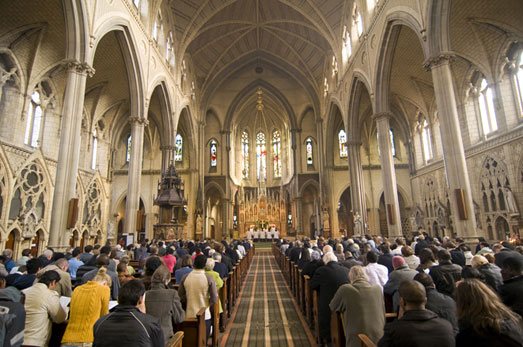
I was confirmed at Catholic mass


I attended a Catholic mass last Tuesday and heard the Bishop of Columbus speak. He said something that has changed my view of religion in a deep and meaningful way. In fact, after he confirmed the class of young people, he confirmed my formula to power.

In conclusion to his talk, the bishop said that unless you know, love, and serve God, you cannot be happy. I found it important that he concluded by mentioning the key to personal happiness.

So God brings us happiness…but how?

I thought about this and realized that God has absolute power. We do wrong and he tells us to accept him as having this power and he will take away that sin. Fault is our feeling from doing wrong. If God takes away that fault, we can be happy and that’s the only way we can be happy.

So why are people, both Christians and others, still unhappy?

Christianity is misused. Some followers rely on others for their connection to God. Their minister, their priest, other authority figures. But Chrisitianity tells us we need a personal relationship with God.

There is another misuse: We help others before we help ourselves. We feel good about ourselves through these actions, but Christianity tells us that the crux of finding happiness isn’t through our actions, it’s through recognizing we make mistakes and are imperfect. And this knowledge, not action, is where we must start:

We must accept ourselves

Religion fails -rather, WE fail- when we jump ahead of this state of mind: We fail as Christians when we think going to a church and giving to others will make us happy. We cannot be happy unless we know ourselves. Knowing God and knowing ourselves is the same thing. The saying God is love makes sense: When we know God, we love ourselves despite being imperfect.

But God cannot accept our guilt, only we can. The Bishop did not say God knows us. He said WE must know God. That’s why when we’re unhappy, it’s not God’s fault. It’s our fault. And once we accept this fault, we accept responsibility for ourselves. We lose that ego, we lose that worry. We become free and empowered.

Once we’re free from worry, we immediately become connected to others, because we see that everyone else is imperfect, too, and we’re not separate from them. And we see that when we don’t help them, it’s like not helping ourselves.

Freedom and connection are the consequences of accepting our imperfection. And freedom is happiness.

The Bishop was correct that we cannot be happy without knowing, loving and serving this idea: Accept your imperfections.

I thank the Bishop for confirming this in me.