The sound of inevitable death

Agent Smith was right. Death is inevitable.

Neo lived here, but he did later die. I am going to die. You are, too. We’re all going to die. We all will cease to exist one day. It is inevitable. All the bad stuff that happens to us will pass. The good stuff, too. Focusing on any of that while death looms is silly when you think about it. We win the lottery everyday when we wake up in the morning with the ability to perceive our surroundings and make conscious choices about what we want or where we want to go.

I remember feeling like Neo not long ago, when I woke up from my Matrix. I had been following a life that others had constructed. I had values, but they were borrowed. I had causes, but I was only using them to bring meaning to my life. And so awake, I was able to see I was far from the person I wanted to be. I was pretty disgusted when I’d finally lifted the covers I’d thrown over the sordid mess that was my personality. All I did was judge myself and other people. I was such a pessimist I don’t know how anyone wanted to be around me. Listening to your internal dialogue is so powerful, but it can be depressing!

So this was hard. But it’s been even harder to accept myself. Actually, I might never fully accept myself, but that is a goal of perfection: Realizing we are imperfect and not worrying about it.

A great way of pushing thru realized imperfection is pressure

Back to Neo. He was facing some pressures in the real world. He’d just taken the red pill, instead of the blue pill, and woken up from a virtual reality world of a comfortable life. He finds himself in the sewers of a city, being chased by robots. Just as Cypher, one of the other human refugees from the Matrix told him: “I know what you’re thinking. Why oh why didn’t I take the blue pill?”

Cypher wanted to escape the real world and go back to the Matrix. I think we all feel that way sometimes. We want to hide behind a fierce attitude, the pride in our career, the pleasure in a partner or our children, or a respectable cause to fight for. Instead of facing reality, we find it easier to escape it, placing importance on things or gaining value from other people when that value should originate in ourselves.

I think the pressure to survive helped Neo. This is a pressure we don’t have. Consequently, we can get distracted, or we can become so focused on doing the right thing, we become overwhelmed by the task. I’ve awakened from the distractions, but I’m still overwhelmed sometimes.

Whether we’re distracted or overwhelmed, we need to keep the inevitability of death in our heads. This will bring about the gratitude and the focus on the here and now, and once we’re focused, we’re not worried about needing anything from anyone. We start controlling our lives, instead of letting others do it for us. We are better able to make ourselves happy.

The sound of inevitability: It’s good to hear that sound to put things in perspective.
TED Talk Tuesday: Paul says it’s time to start being fearful


Fear is not bad. Although as the foundation for your actions -the conservative hand that holds you back from trying- it is certainly a bad thing. But fear is helpful. A useful servant, but a terrible master. Good fear results from being aware of our worsening conditions. It comes from being able to judge clearly.

Paul Gilding helps us clarify the situation that the world’s rate of consumption is unsustainable. And it’s time to start being fearful. As he puts it, it’s time to end the denial:

“We tend to look at the world, not as the integrated system that it is, but as a series of individual issues. We see the Occupy protests, we see spiraling debt crises, we see growing inequality, we see money’s influence on politics, we see resource constraint, food and oil prices. But we see, mistakenly, each of these issues as individual problems to be solved. In fact, it’s the system in the painful process of breaking down — our system, of debt-fueled economic growth, of ineffective democracy, of overloading planet Earth, is eating itself alive.”
He suggests fear, but fear is not enough.

Empowerment is necessary, too. It’s time to start empowering people to know what they’re doing. What we’re doing when we go shopping, when we choose what to eat, where to work, who to bank with, and what media to view. It’s time to enable ourselves.

Spread the confidence to unplug from our current lifestyle -energy use, meat consumption, sprawling residences- and find better ways to do things. I don’t even see this as a sacrifice, because what we seek is not really at the end of a checkout line, or sitting in a nice car and nice clothes, or eating a steak. What we want is a connection with other people.

It’s time to be fearful. And then time to re-evaluate what we’re doing in our search for happiness. We may not only be missing that mark, but taking down our society and planet as well.

“It takes a good crisis to get us going. When we feel fear and we fear loss we are capable of quite extraordinary things.”

It’s time to be extraordinary.

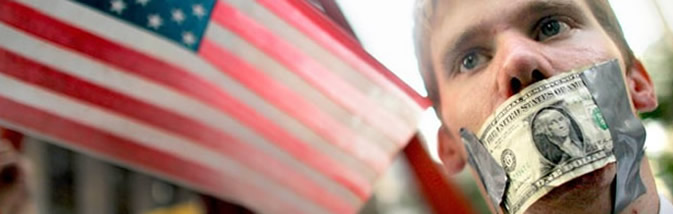
Remove the money gag

How would you rate the following in importance?

-Tax breaks for gay and straight married couples
-Wall Street banks paying fines a fraction of the $30 trillion the government loaned them to keep their collapse from taking down our economy.
-Government money to cover contraception

What do we need to focus on? All of these involve controlling money. Is that the problem?

The money isn’t the problem. It’s how the government is engineering the country as if money is our only motivator.

Good leaders trust the human spirit, not carrots and sticks

Good leaders don’t use regulations and incentives. But our leaders are doing so today. They’re trying to regulate Wall St bankers to prevent their recklessness from hurting us again in the future. But regulations restrict us and push us to find a way around them. That is why three times since 1990, the banks have almost collapsed and why the government bailed them out each time. If you knew you were going to get your money back, would you be more or less careless when spending it?

And incentives? Incentives bribe us. Research shows that when you start giving rewards, people are pretty predictable. They stop doing for the sake of doing, and shift to doing for the reward. When you start going to work so that you can get money to buy stuff, the stuff becomes the reward and the job becomes less of a choice.

We’re not animals. But if you use carrots and sticks on us, we will tune our motivations to that type of environment

How can these two things be the foundation of leadership, of government, of a community?

They can’t.

Are there any leaders today that inspire you? Most leaders of today aren’t going to be the people in government. Those who seek power in a system that has been compromised have compromised themselves. Granted, they may change some things. They may nibble at the fringes. But that cancer still grows inside.

Despite what media and culture tells us, leaders aren’t special. They aren’t chosen by divine providence or fate. They don’t have abilities different than you and me. Do you empower others? Ask people what they think? Do you encourage people? Then you’re probably a leader, or you can become one now that you see what it takes.

Leaders make things happen, yes. But:

“A leader is best when people barely know he exists, when his work is done, his aim fulfilled, they will say: we did it ourselves”

This Taoist quote tells us it’s about us doing something. It’s always been about us. And I think we can do this. It’s going to require us to remove the gag of money that has both silenced and motivated us. It’s going to require looking past the “I want to get mine if they’re getting theirs”. It’s going to require stopping the consumer train, and looking at what we’re feeding the engine. It’s going to require putting our heads together and not letting party or social class or emotions divide us and distract us from doing the right thing.

Let’s kill the noise and start listening to reality

Elections are where we can flex our muscle. But we’ve got to do our homework before then. Listen to what’s being reported. Do you think it’s important? We’ve got to talk to people and not be afraid to ask them why they believe what they do. Your neighbor isn’t stupid or lazy, and neither are you. Politics isn’t personal. It’s what a community depends on for its survival! And if we think one party or one person can fix this country, we’ve missed the point. This country is here because people had the courage of their convictions to join together and risk everything for what they believed in.

I think we can step up and be leaders again.

TED Talk Tuesday invaded by FOX News: What if…?


“What if the two-party system were actually a mechanism used to limit so-called public opinion? What if there were more than two sides to every issue, but the two parties wanted to box you in to a corner, one of their corners?

What if there’s no such thing as public opinion, because every thinking person has opinions that are uniquely his own?

What if public opinion were just a manufactured narrative that makes it easier to convince people that if their views are different, there’s something wrong with that – or something wrong with them?

What if the whole purpose of the Democratic and Republican parties was not to expand voters’ choices, but to limit them?

What if those vaunted differences between Democrat and Republican were actually just minor disagreements?

What if both parties just want power and are willing to have young people fight meaningless wars to enhance that power?

What if both parties continue to fight the war on drugs just to give bureaucrats and cops bigger budgets and more jobs?

What if government policies didn’t change when government’s leaders did?

What if no matter who won an election, government stayed the same?

What if government were really a revolving door of political hacks, bent on exploiting the people while they’re in charge?”

Who watches the watcher?
The answer is clear.
It’s you and me!
An enlightened and knowledgeable population.
The government and corporations and banks don’t rule us.
They serve us.
We can change the power imbalance that has drifted to them.

Yes.
We can.

TED Talk Tuesday – Gary says do what you love

A little entertainment for you this Tuesday, but it’s a funny and inspiring video by the most excitable guy I’ve seen in small business:

“Lets start with passion, there’s way too many people in this room right now that are doing stuff they hate. Please stop doing that. There is no reason in 2009 to do crap you hate. None. Promise me you won’t, because you can lose just as much money being happy as hell.”

His name is Gary Vaynerchuk. And he’s real:

“nine to five, I don’t have time. If you want this, if you’re miserable, or if you don’t like it or you want to do something else and you have a passion somewhere else. Work nine to five. Spend a couple hours with your family. Seven to two in the morning is plenty of time to do damage. But that’s it. It’s not going to happen any other way.”

Stay hungry, my friends.

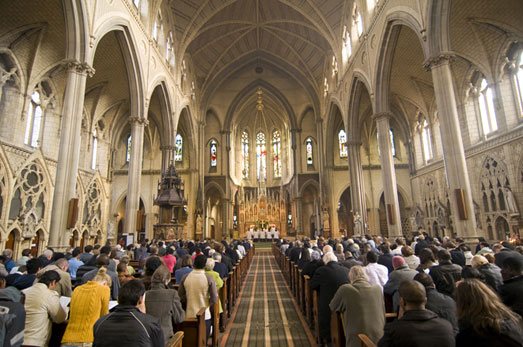
I was confirmed at Catholic mass


I attended a Catholic mass last Tuesday and heard the Bishop of Columbus speak. He said something that has changed my view of religion in a deep and meaningful way. In fact, after he confirmed the class of young people, he confirmed my formula to power.

In conclusion to his talk, the bishop said that unless you know, love, and serve God, you cannot be happy. I found it important that he concluded by mentioning the key to personal happiness.

So God brings us happiness…but how?

I thought about this and realized that God has absolute power. We do wrong and he tells us to accept him as having this power and he will take away that sin. Fault is our feeling from doing wrong. If God takes away that fault, we can be happy and that’s the only way we can be happy.

So why are people, both Christians and others, still unhappy?

Christianity is misused. Some followers rely on others for their connection to God. Their minister, their priest, other authority figures. But Chrisitianity tells us we need a personal relationship with God.

There is another misuse: We help others before we help ourselves. We feel good about ourselves through these actions, but Christianity tells us that the crux of finding happiness isn’t through our actions, it’s through recognizing we make mistakes and are imperfect. And this knowledge, not action, is where we must start:

We must accept ourselves

Religion fails -rather, WE fail- when we jump ahead of this state of mind: We fail as Christians when we think going to a church and giving to others will make us happy. We cannot be happy unless we know ourselves. Knowing God and knowing ourselves is the same thing. The saying God is love makes sense: When we know God, we love ourselves despite being imperfect.

But God cannot accept our guilt, only we can. The Bishop did not say God knows us. He said WE must know God. That’s why when we’re unhappy, it’s not God’s fault. It’s our fault. And once we accept this fault, we accept responsibility for ourselves. We lose that ego, we lose that worry. We become free and empowered.

Once we’re free from worry, we immediately become connected to others, because we see that everyone else is imperfect, too, and we’re not separate from them. And we see that when we don’t help them, it’s like not helping ourselves.

Freedom and connection are the consequences of accepting our imperfection. And freedom is happiness.

The Bishop was correct that we cannot be happy without knowing, loving and serving this idea: Accept your imperfections.

I thank the Bishop for confirming this in me.

The most difficult decision of my life

There are some actions that are not right, but context defines our decisions. Sometimes we must do the wrong thing at the right time. Me walking away from a medical degree, for instance. It was what needed to be done at the time, much to people’s disbelief. But I wasn’t living my life. My life was living me.

What is indisputable is that we’re here to do something worthwhile. And who is the one that’s going to tell you what that thing is?

Well, that’s going to be you. Not society. Not your parents. Not your neighbors, and not your partner.

The how and the why is answered by you, and you alone.

Your values are what make your actions your own.

Food is more than fuel

On my way home last week I stopped at Chipotle, a restaurant famous for its burritos. After I got my food, I made my way home, and I passed a Firehouse Subs restaurant, a McDonald’s, a Taco Bell, and a Burger King. The drive-thrus were lined with cars with people waiting for their own quick meals. At home, I ate the burrito, my hunger driving me past savoring the taste to get the food in my stomach. Afterwards, I grabbed a bag of banana chips, and as I snacked, I looked at the ingredients.  The first ingredient read, “Bananas”. The last one read “Banana flavor”. As I sat there on my couch, I felt full and satisfied, and ready to tackle my chores, but I didn’t feel good. Why?

Although the food was real, I didn’t know what I’d eaten

The restaurant workers were nice enough. The cashier even talked to me beyond the usual banter, but all I did was hand over my credit card. A quick swipe and I was done. I had eaten alone, speaking to no one.  I had finished quickly, but usually I am the slowest eater in the dinner party. I chew and talk, while others chew and swallow.

I like picking parsley from my garden and chopping it on my cutting board

From my couch, I looked out my window, and saw the parsley growing in my garden. I liked hearing it crunch under my knife, and suddenly smelling its fresh and pleasant fragrance. I would mix it into the noodles that I had cooked, and the aroma of the tomato sauce and capers and parsley danced together into my nose. I would look at what I’d made, swirl a bite onto my fork, and chew it. It was a good experience. It made me happy.

I knew it would be a long time before I’d have the full and satisfied feeling of a restaurant burrito and  bananas with banana flavoring.

And that was ok by me.